

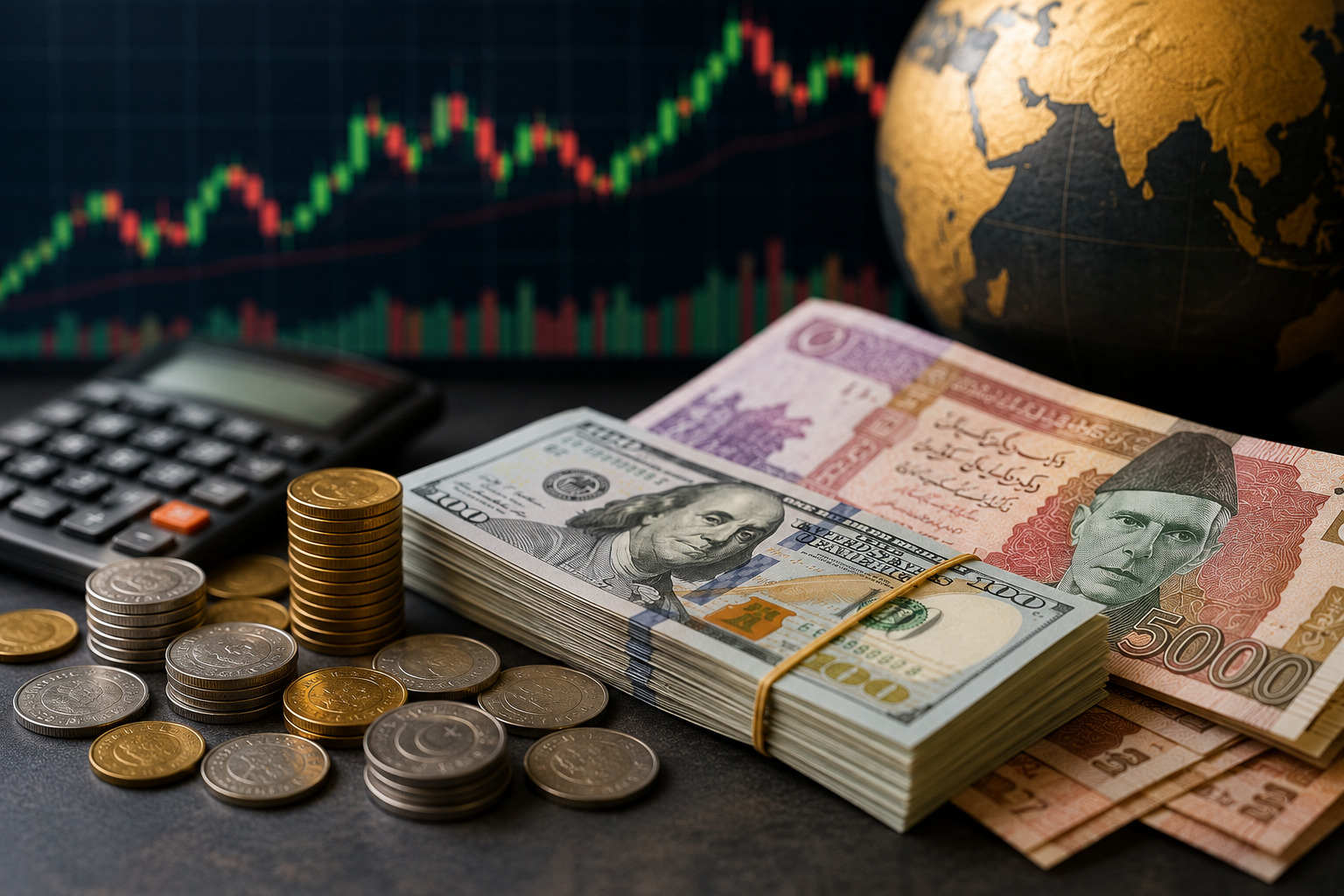
Despite minor fluctuations in foreign exchange rates in Pakistan’s open market, the US dollar remains in a strong position, while the Pakistani rupee is showing relative stability against major global currencies. According to the latest open market data, the purchase of the US dollar was recorded at Rs 278.25 and the sale at Rs 279.40.
Economic experts say that the relatively stable performance of the rupee in recent weeks reflects that uncertainty in the foreign exchange market has reduced to some extent; however, global financial conditions and pressure on import payments are still important factors for the market.

The British pound was traded at Rs 371.81 for purchase and Rs 375.60 for sale in the open market, while the price of the euro was recorded at Rs 321.06 for purchase and Rs 327.55 for sale. Both currencies have been the focus of investors due to ongoing global economic changes and central bank policies.
The prices of the Saudi riyal and the UAE dirham are of particular importance for millions of Pakistanis working in Gulf countries. The Saudi riyal was available at Rs 74.05 for purchase and Rs 74.80 for sale, while the UAE dirham was available at Rs 75.70 for purchase and Rs 76.65 for sale. According to experts, remittances from overseas Pakistanis are playing an important role in supporting the country’s foreign exchange reserves.
Forex market analysts say that the US Federal Reserve’s interest rate policy, global oil prices and regional trade activities will play an important role in determining the future direction of the Pakistani rupee. If the dollar strengthens further in global markets, its effects may also be felt on the local currency market.
On the other hand, the stability in the rates of Gulf currencies is being considered a positive signal because a large part of Pakistan’s imports and remittances are linked to these countries. The Kuwaiti dinar remained among the most expensive currencies with a purchase price of Rs 885.11 and a sale price of Rs 896.99, while the Bahraini dinar and the Omani rial also remained at high levels.
Experts warn that the difference between open market rates and banking sector rates sometimes indicates an imbalance in supply and demand, so importers, exporters and investors should constantly monitor the market situation.
Overall, the current forex data shows that the Pakistani rupee is not under severe pressure; however, market participants are adopting a cautious attitude due to global economic uncertainty. Developments related to remittances, import bills and State Bank policies in the coming days may further clarify the trend of the currency market.
| Flag | Code | Buying (PKR) | Selling (PKR) |
|---|---|---|---|
 | USD | 278.20 | 279.45 |
 | GBP | 371.12 | 376.60 |
 | AED | 75.65 | 76.60 |
 | CHF | 350.35 | 356.85 |
 | SEK | 30.27 | 30.57 |
 | SGD | 214.98 | 220.83 |
 | SAR | 74.00 | 74.75 |
 | QAR | 75.22 | 76.15 |
 | OMR | 719.22 | 730.32 |
 | NOK | 27.88 | 28.18 |
 | NZD | 159.76 | 164.81 |
 | MYR | 67.18 | 67.88 |
 | KWD | 884.52 | 894.65 |
 | THB | 8.53 | 8.68 |
 | JPY | 1.7218 | 1.8209 |
 | INR | 2.80 | 3.05 |
 | HKD | 34.97 | 35.90 |
 | EUR | 320.79 | 324.35 |
 | DKK | 43.39 | 43.79 |
 | CNY | 38.05 | 38.80 |
 | CAD | 198.13 | 203.35 |
 | BHD | 734.83 | 744.90 |
 | AUD | 194.24 | 199.65 |