
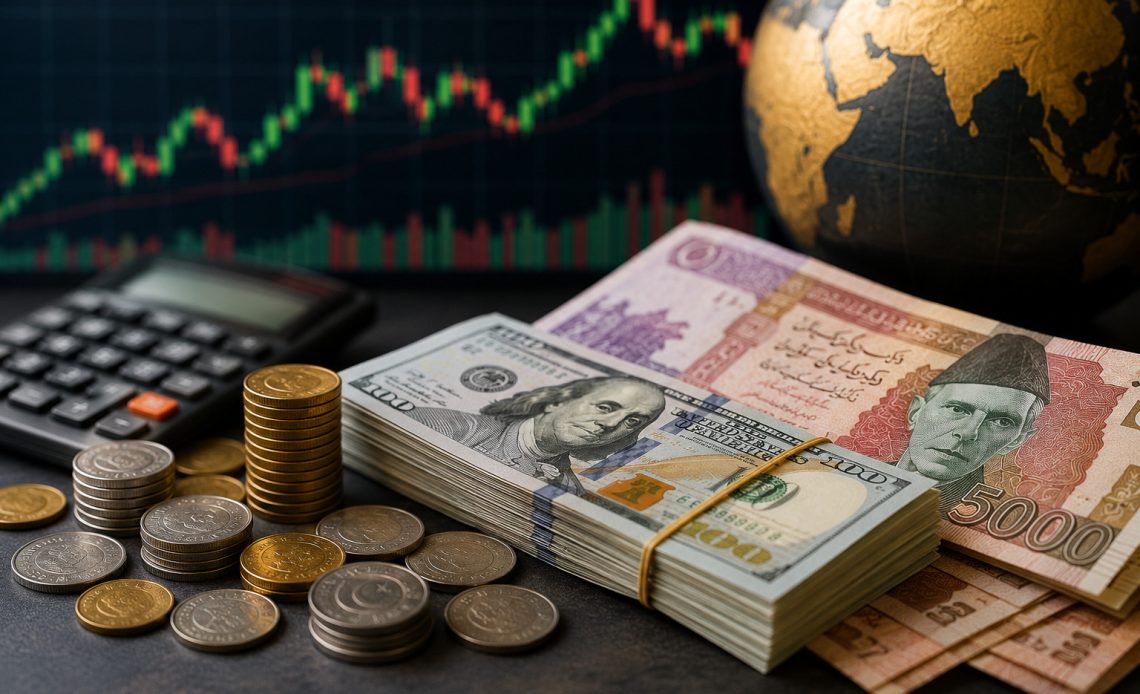
The rates on Pakistan’s interbank currency market on June 10, 2026, reflect an economic environment where tight monitoring is underway at both the policy and market levels to protect the rupee’s value from artificial pressure.
The US dollar remained at Rs 278.25 for buying and Rs 278.75 for selling, indicating that the market is in a “stable range trading pattern” rather than experiencing immediate volatility. The British pound and the euro also remained relatively stable, but their high levels are putting pressure on Pakistan’s import bill.
According to financial experts, the real concern is not the currency’s value but the factors behind this stability. A drop in imports, an increase in remittances and the intervention of the State Bank of Pakistan have provided temporary support to the rupee, but long-term pressure still remains.
The slight difference in the prices of Gulf currencies such as the AED and SAR directly affects Pakistan’s energy import costs. The Saudi Riyal at 74.11 and the Dirham at 75.76 are evidence that a large part of Pakistan’s external payments are still linked to the Gulf economies.
The limited movement in the value of the Chinese yuan indicates the continuation of CPEC projects, but uncertainty in trade volumes still exists. The relatively low movement of the Canadian dollar and the Australian dollar is a result of the stability in global commodity prices.
According to analysts, if Pakistan fails to reduce import pressure, these “stable” rates may again come under pressure in the coming months. At present, the market is seeing more “policy balance” than real stability.
| Flag | Code | Bank Buying | Bank Selling |
|---|---|---|---|
 | USD | 278.25 | 278.75 |
 | GBP | 372.46 | 373.13 |
 | EUR | 321.33 | 321.91 |
 | AED | 75.76 | 75.9 |
 | SAR | 74.11 | 74.24 |
 | CAD | 199.49 | 199.85 |
 | AUD | 195.39 | 195.74 |
 | CNY | 41.06 | 41.13 |
 | HKD | 35.51 | 35.57 |
 | JPY | 1.74 | 1.74 |
 | SGD | 216.15 | 216.54 |
 | SEK | 29.37 | 29.43 |
 | CHF | 348.25 | 348.88 |
 | THB | 8.45 | 8.47 |