
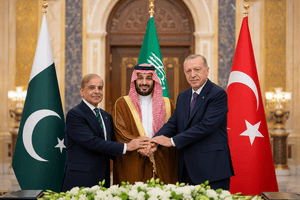
Prime Minister Shahbaz Sharif has welcomed the positive response of US President Donald Trump to the Mecca joint defence agreement between Pakistan, Saudi Arabia and Turkey. The prime minister said that Islamabad will continue to play a constructive role in regional defence and peace with its allies.
Shehbaz Sharif called Trump’s statement encouraging. He said that Pakistan sees cooperation with Saudi Arabia and Turkey as linked to broader regional security.
The prime minister also appreciated the role of the US president in reducing tensions in South Asia. He called sustainable peace a fundamental requirement for a secure and prosperous future for the people.
This reaction came after Trump described the Mecca Defence Agreement as an important step. The US president also congratulated the leadership of Pakistan, Saudi Arabia and Turkey.
The three countries signed the agreement on August 7 in Mecca. The basic principle of the agreement is that an armed attack on one of the members is considered an attack on all three.
This arrangement is expected to further streamline defence coordination among the three countries. According to Turkey, a permanent mechanism for high-level political and military consultations will also be created in the future.
There was no talk of limiting defence cooperation to traditional military areas. The plans include land, naval and air exercises as well as cybersecurity, unmanned systems and advanced defence technology.
This aspect is of particular importance to Pakistan. Islamabad is already increasing cooperation with Turkey in the defence industry and military technology. Pakistan also has long-standing defence relations with Saudi Arabia.
Another notable feature of the agreement is its potential scope. Turkish President Recep Tayyip Erdogan has said that Egypt could become part of this defence arrangement in the future. According to him, the agreement is also open to other countries.
The possible inclusion of Egypt could give this cooperation a wider regional significance. Cairo holds significant political and military weight in the Arab world.
However, the real usefulness of the agreement will be clear from its practical implementation. Joint defence planning, military coordination and coordination between the defence systems of different countries will be important stages of this process.
Analytically, the agreement has come in an environment where the security situation in the Middle East is changing rapidly. Rising tensions in the region have forced many countries to reconsider their defence priorities.
In this context, the joint defence framework of Pakistan, Saudi Arabia and Turkey is not limited to military cooperation. It also reflects the growing strategic ties between the three countries.
For Islamabad, an important aspect of this agreement is also to maintain regional balance. Pakistan has consistently taken the position that regional issues should be resolved through diplomacy and cooperation rather than tension.
Despite the agreement, it would be premature to draw any immediate final conclusions about its impact. Its direction will be clearer from the upcoming joint exercises, defence planning and the inclusion of possible new members.
For now, it is clear that the Mecca Defence Agreement has linked the relations of Pakistan, Saudi Arabia and Turkey into a new defence framework. The possible inclusion of Egypt could further expand the scope of this cooperation.
We welcome your contributions to The Pakistan Today. Submit your blogs, articles, press releases, news story pitches and news features to our editorial team.
Please send your submissions to our News Desk or Editorial team. We look forward to hearing from writers, journalists and contributors.