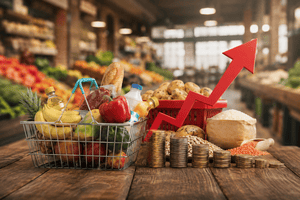

The continuous increase in flour prices in Pakistan has further increased the problems of the people, while on the one hand the government is claiming subsidies and controlled rates, while on the other hand prices in the market are touching new heights.
According to the latest report of the Federal Bureau of Statistics, the price of a 20 kg bag of flour has increased from Rs 40 to Rs 590 in different cities of the country in just one week. This increase has become a cause of further concern for citizens already crushed under the pressure of inflation.
According to official data, the price of a 20 kg bag of flour in Islamabad has reached Rs 2,893.33, which is the highest price in the country. In Rawalpindi, the same bag is being sold for Rs 2,866.47, while in Peshawar the price has reached Rs 2,850.
In Karachi, a 20 kg bag of flour is available for Rs 2,600, while in Quetta the price has reached Rs 2,660. In Bannu, this bag is being sold for Rs 2,800.
According to the data, the price of flour in Karachi, Peshawar, Sukkur and Larkana has increased by Rs 100, in Hyderabad and Sialkot by Rs 80, in Bannu by Rs 50 and in Lahore by Rs 40.
On the other hand, the Punjab government says that the flour milling sector is being mobilized to stabilize the shortage of flour and prices. According to Director Food Punjab Amjad Hafeez, 770 flour mills have started grinding wheat in the province, out of which 514 flour mills are being supplied with subsidized wheat.
According to him, lakhs of flour bags are being supplied in the market every day and a 10 kg flour bag is available for Rs 905 while a 20 kg bag is available for Rs 1810. However, citizens say that in most markets these rates are proving to be only paper claims.
Citizens say that there is a clear difference between the official rates and the actual market prices, due to which the common man is not getting any real relief. The public demands that the government should effectively control prices instead of just releasing figures.
According to economists, flour prices are directly affected by factors such as wheat procurement, transport costs, and storage. If these factors are not controlled, it will be difficult to reduce prices.
Analysts say that it is important for the government to tighten supervision of flour mills, pass on the subsidy benefits directly to the consumer, and take effective action against hoarders.
Currently, the public is hopeful that government measures will be seen in practice in the coming days and a basic necessity like flour will be able to return to the reach of the common man.
We welcome your contributions to The Pakistan Today. Submit your blogs, articles, press releases, news story pitches and news features to our editorial team.
Please send your submissions to our News Desk or Editorial team. We look forward to hearing from writers, journalists and contributors.