


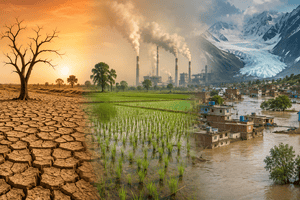
The impacts of climate change in the country are no longer limited to natural disasters but are also putting significant pressure on key sectors related to national development, economic stability and public welfare. Experts say that changing weather patterns have made it clear that including climate risks as a fundamental element in development plans has become the need of the hour.
In recent years, severe heat waves, unbalanced rainfall, flash floods, droughts and fluctuations in water availability have affected the daily lives and local economies in different areas. According to meteorologists, the increasing intensity of such events indicates that the country will have to be more prepared than before for future risks.

The United Nations Pakistan Annual Report 2025 also emphasizes that the impacts of climate change are being felt simultaneously in different sectors. According to the report, agricultural production, water resources, public health and economic activities are areas where climate pressures may become more significant in the coming years.
The glacial deposits in Pakistan’s northern mountainous regions are of fundamental importance to the river system and agricultural economy. However, the continuous increase in temperature has increased the rate of melting of these glaciers, which is also increasing the risk of glacial lakes and flash floods in some areas. According to experts, emergency measures alone are not enough to deal with this situation, but long-term water planning is also necessary.
The agriculture sector, which is a source of employment for millions of people, is being directly affected by climate uncertainty. Unpredictable changes in weather are affecting crop cultivation, production and quality, while farmers are facing new challenges in terms of irrigation, seed selection and production costs. Agricultural experts emphasize the need to promote modern technology, weather forecasts and climate-friendly agricultural practices.
Air pollution and smog in urban areas are also compounding climate and environmental problems. According to health experts, polluted air poses additional risks to patients with respiratory and heart diseases, while clean energy, low-emission transport and better urban planning are considered long-term solutions.
Experts say that protecting forests, water bodies and natural ecosystems can play a significant role in reducing the impacts of climate change. Along with tree plantations, protecting existing forests, responsible use of natural resources and promoting biodiversity also need to be made part of the national strategy.
The government and international partners are working on various environmental and renewable energy projects, but according to experts, success depends not only on the announcement of projects but also on their effective implementation, local implementation and public participation.
According to analysts, only coordinated policy-making, modern infrastructure, scientific research and investment in local capacity, considering climate change not as a future but as an economic and social challenge of the present era, can make Pakistan more resilient to climate risks.