
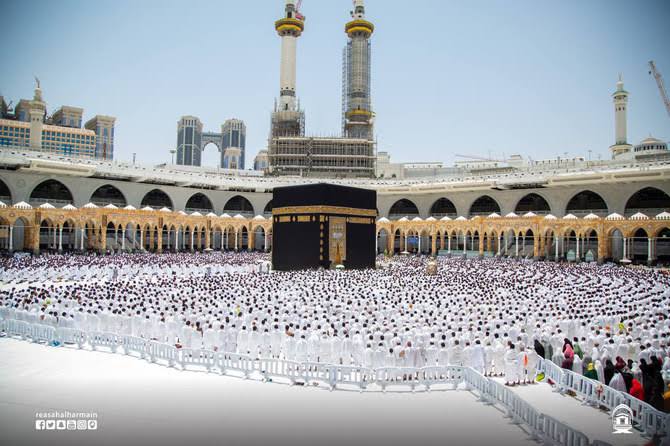
The federal government has introduced a new policy to modernise Hajj arrangements, focusing on digital technology, long-term planning and empowering pilgrims. According to officials, the new Hajj policy is not just about administrative changes but also about making Hajj services more transparent, effective and convenient.
Federal Minister for Religious Affairs Sardar Muhammad Yousaf, while giving details of the new policy, said that Pakistan’s total Hajj quota has been maintained at 179,210, while the 60:40 ratio of government and private Hajj schemes will also remain. However, if the need arises in the future, the federal cabinet will be able to review this ratio.
The most prominent aspect of the policy this time is the advance registration system. For the first time, the government has decided to provide citizens with the facility of registering four years before Hajj. Applicants will be able to secure their application by initially depositing only 10 percent of the expected expenses, while the selection will be done through a completely digital waiting list to ensure transparency and equal opportunities.
The Ministry of Religious Affairs has also made provision for long-term contracts of three to four years for various services, including accommodation, transport, catering, air travel and luggage delivery, for better planning in Hajj arrangements. According to officials, this move will not only improve administrative continuity but also enable better control over expenses.
Under the new policy, several packages with different durations and costs will be introduced in the government Hajj scheme so that citizens with different incomes can choose the appropriate package according to their needs and financial capacity. The ministry has indicated that the registration and payment schedule will be released soon.
The government has also decided to fully integrate the Hajj operation with digital governance. All steps, including registration, payment, monitoring, filing of complaints and their redressal, will be done online. The use of the Private Hajj Management Portal (PHMP) has been made mandatory for private Hajj companies to make the booking, financial transactions and audit process more transparent.
The government says that in the future, the role of the Ministry of Religious Affairs will focus on regulatory oversight, quality assurance and ensuring transparency rather than directly running Hajj operations, while the responsibilities of the private sector will be gradually increased.
The Federal Minister for Religious Affairs said that the new Hajj policy has been prepared keeping in mind the instructions of Prime Minister Shehbaz Sharif and the requirements of Saudi Vision 2030. According to him, these reforms are an important step towards providing modern, safe and world-class Hajj facilities to Pakistani pilgrims.