
Iran has said that its seven-point proposal remains the basis for diplomatic engagement with the United States, adding that Washington must respond to Tehran’s demands to move negotiations forward.
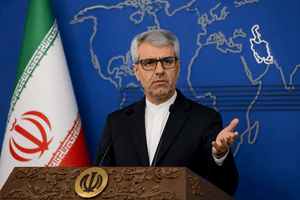
Foreign Ministry spokesperson Esmaeil Baghaei made the remarks during a press conference in Tehran on Monday. He said Iran’s demands were clear and that the next move rested with the United States.
Baghaei indicated that the proposal could be implemented within the next few days. According to other details provided by Iranian officials, the revised plan could be completed within two days instead of the original seven-day timeframe. ReutersFeed+1
The spokesperson said Iran would not agree to a final arrangement or reopen the Strait of Hormuz unless the United States ended its naval blockade and addressed Tehran’s demands.
He described the conditions as necessary for reaching an agreement and restoring security in the strategically important waterway.
Qatar facilitates diplomatic contacts.
Baghaei confirmed that communication between Tehran and Washington was continuing through intermediaries.
He said Iranian Deputy Foreign Minister Kazem Gharibabadi had visited Doha to facilitate the exchange of messages between the two sides through Qatari mediation.
The spokesperson also said Iran did not expect the US midterm elections to bring a significant change in Washington’s approach towards Tehran.
The latest diplomatic contacts come amid continuing tensions over the naval blockade, regional security and the future of the Strait of Hormuz.
Iran criticises US position on the International Criminal Court
The Iranian spokesperson also accused the United States of putting pressure on the International Criminal Court (ICC) over its legal proceedings involving Israeli officials.
Baghaei said the court was facing significant pressure for pursuing cases under its legal procedures. He criticised Washington’s approach, alleging that it had undermined diplomatic efforts over the past two years rather than helping establish a peaceful solution.
These allegations reflect Tehran’s position on the international legal proceedings and US policy towards Israel.
Iran raises concerns over Gaza and Lebanon.
Baghaei also criticised Israel’s military operations in Gaza and Lebanon, describing Israeli actions as a major source of insecurity in West Asia.
He expressed concern over the humanitarian situation facing displaced Palestinians and Lebanese civilians, particularly with colder weather approaching.
The spokesperson said restrictions on the delivery of essential supplies were worsening conditions for displaced people.
He also criticised the international community and European countries for what he described as an inadequate response to the humanitarian crisis.
Baghaei warned against treating civilian casualties as mere statistics, saying that normalising human suffering posed a serious challenge to international humanitarian principles.