

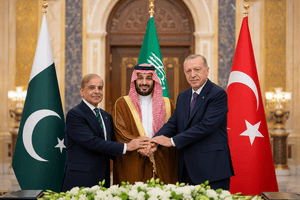
The new joint defence agreement between Pakistan, Saudi Arabia and Turkey has sparked a new debate on the region’s security policy. This move by the three countries comes at a time when security concerns in the Gulf and the Middle East, security of sea routes and regional tensions have raised questions about the old defence arrangements.
Although the agreement signed in Mecca is being considered a major defence breakthrough, it is not appropriate to immediately interpret it as a new military bloc or an ‘Islamic NATO’. Its more prominent aspect is to formalise and organise defence ties between the three countries.


The basic concept of the agreement is that Pakistan, Saudi Arabia and Turkey can use their defence capabilities and experiences with each other more effectively. Joint planning, military training, intelligence cooperation and coordination on potential security challenges can be important parts of this cooperation.
This development can also be considered a result of the changing security environment in the region. In recent years, missile and drone attacks in the Middle East, threats to maritime trade, and the protection of energy facilities have forced Gulf countries to rethink their defence strategies.
The importance of this agreement is particularly significant for Saudi Arabia. A large part of the kingdom’s economy is related to the energy sector, while major economic and infrastructure projects are also underway under Vision 2030. In such an environment, regional stability and the protection of key facilities are among Riyadh’s top priorities.
Pakistan already has long-standing defence cooperation with Saudi Arabia. The training of Pakistani military personnel and contacts in the defence sector between the two countries spans decades. The new trilateral agreement could provide Islamabad with an opportunity to advance the existing defence partnership with Saudi Arabia into a broader regional framework.
Another aspect of Pakistan’s importance is its geographical location. The country is connected through the Arabian Sea to sea lanes that are crucial for Gulf trade and energy transport. Therefore, the security situation in the Gulf is directly linked to Pakistan’s own energy and economic needs.
Turkey’s inclusion adds a distinct defence and technical dimension to the agreement. Ankara has significantly expanded its capabilities in drones, defence electronics, naval systems, and other military technologies in recent years. Turkey’s defence experience could open up new possibilities for cooperation with Pakistan and Saudi Arabia.
However, the existence of the agreement does not mean that the current balance of power in the region has changed overnight. The US’s The defense agreement between Pakistan, Saudi Arabia and Turkey in Mecca could give a new direction to regional security cooperation. Know the importance and possible effects of the agreement.defence installations in the Gulf and long-standing security partnerships are still important. Similarly, Iran’s missile and drone capabilities are also fundamental to any assessment of regional security.
The most important question regarding the agreement is its practical implementation. The real power of defence agreements is not just reflected in the signatures but in the institutional framework that follows: joint exercises, information exchange, and crisis coordination.
This aspect is also important for Pakistan. On the one hand, Islamabad wants to strengthen its defence and economic ties with the Gulf countries; on the other hand, it will have to maintain a balanced diplomatic policy amid rising tensions in the region.
One advantage for Saudi Arabia of expanding its defence partnership with multiple countries is that its security policy is not limited to a single external power. Cooperation with different partners provides Riyadh with more diverse options for its defence needs.
For Turkey, the agreement could also be an opportunity to increase its political and defence influence in the Gulf region. Growing Turkish capabilities in the The defense agreement between Pakistan, Saudi Arabia and Turkey in Mecca could give a new direction to regional security cooperation. Know the importance and possible effects of the agreement.defence industry could form the basis for future joint production, technology, and training projects.
Nevertheless, the biggest test for the three countries will be how to advance defence cooperation in the context of regional stability rather than confrontation against a specific country. The success of the agreement will be more noticeable if it results in increased practical cooperation and strengthened defence preparedness and coordination rather than tension.
Overall, the Mecca defence agreement reflects the changing trend of security partnerships in the region rather than an immediate military revolution. Pakistan, Saudi Arabia and Turkey have tried to bring their defence relations into a new framework, the effects of which will be clear in the coming period by how far the three countries take this agreement forward on a practical level.